Mud Daubers
in Wisconsin
Slim, solitary wasps that build little mud tubes on walls, under eaves, and in garages. Mud daubers have no colony and no swarm, and they almost never sting people. They hunt spiders to feed their young — a quiet, beneficial insect you can usually just leave alone.
What They Do for Wisconsin
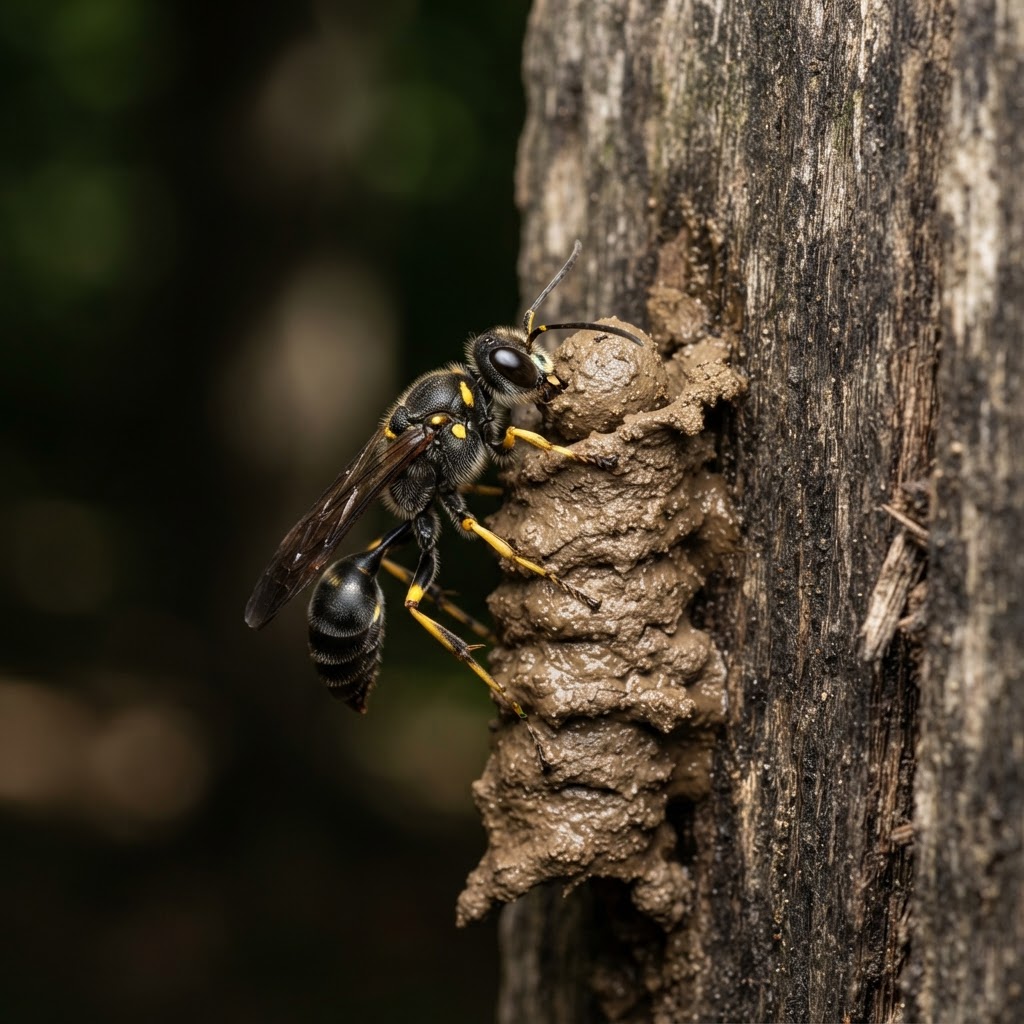
Mud daubers are solitary wasps — there is no queen, no colony, and no swarm. Each female builds her own mud nest, hunts spiders, paralyzes them, and stuffs them into the tubes as food for her larvae. They are excellent, low-key spider controllers and are remarkably non-aggressive: they almost never sting even when handled. If you see mud tubes on your garage wall, the simplest and best response is usually to leave them alone.
What They Do in the Winter
Mud daubers overwinter as larvae inside their mud tubes. The adults die in fall, and the larvae pupate inside the sealed tubes through the winter. New adults emerge the following summer, chew out of the nest, and start the cycle again.
- Overwinter as larvae/pupae sealed inside the mud tubes.
- Adults die in fall — there is no colony to survive.
- New adults emerge the following summer and chew out of the old tubes.
- Old, empty mud tubes can be left up or scraped off; they are not reused.
Nesting
Each female builds her own mud nest — cylindrical tubes, organ-pipe rows, or rounded blobs — on walls, under eaves, in garages, sheds, and attics. There is no colony; every tube is one wasp's work. Three common Wisconsin species build different shapes: organ-pipe, black-and-yellow, and blue.
Diet
Mud dauber larvae eat paralyzed spiders — each tube is stocked with several spiders sealed inside. Adults drink nectar for energy and do not eat the spiders themselves.
- Spiders (paralyzed and stored in mud tubes for larvae)
- Nectar (adults)
- Tree sap and honeydew (occasionally)
- No interest in human food
Fast Facts
Mud daubers are solitary — there is no colony to defend, so there is almost never a swarm or mass attack.
They can sting but almost never do unless physically grabbed; they are among the calmest wasps in Wisconsin.
A single female provisions dozens of spiders for her young — free spider control around your home.
Wisconsin has organ-pipe, black-and-yellow, and blue mud daubers, each building a different-shaped mud nest.
Active tubes should be left alone; old empty tubes can be scraped off with a putty knife in fall or winter.
If you see a lone, slim wasp carrying a mud ball or hovering near a wall, it is a mud dauber — not a threat.
Protect, Don't Exterminate
Honeybees are essential pollinators — we do not treat them as pests. If a colony has moved into your wall, chimney, or a high-traffic area, the right move is live relocation by a beekeeper, not extermination. We can help you find a local beekeeper and handle any follow-up exclusion so they don't return.
Learn About Bees & Pollinators