Carpenter Bees
in Wisconsin
Large, fuzzy bees that look like bumble bees but drill perfectly round holes in unpainted wood to lay their eggs. They pollinate flowers — but over years they can damage decks, siding, fascia, and trim, and woodpeckers often make it worse hunting the larvae inside.
What They Do for Wisconsin
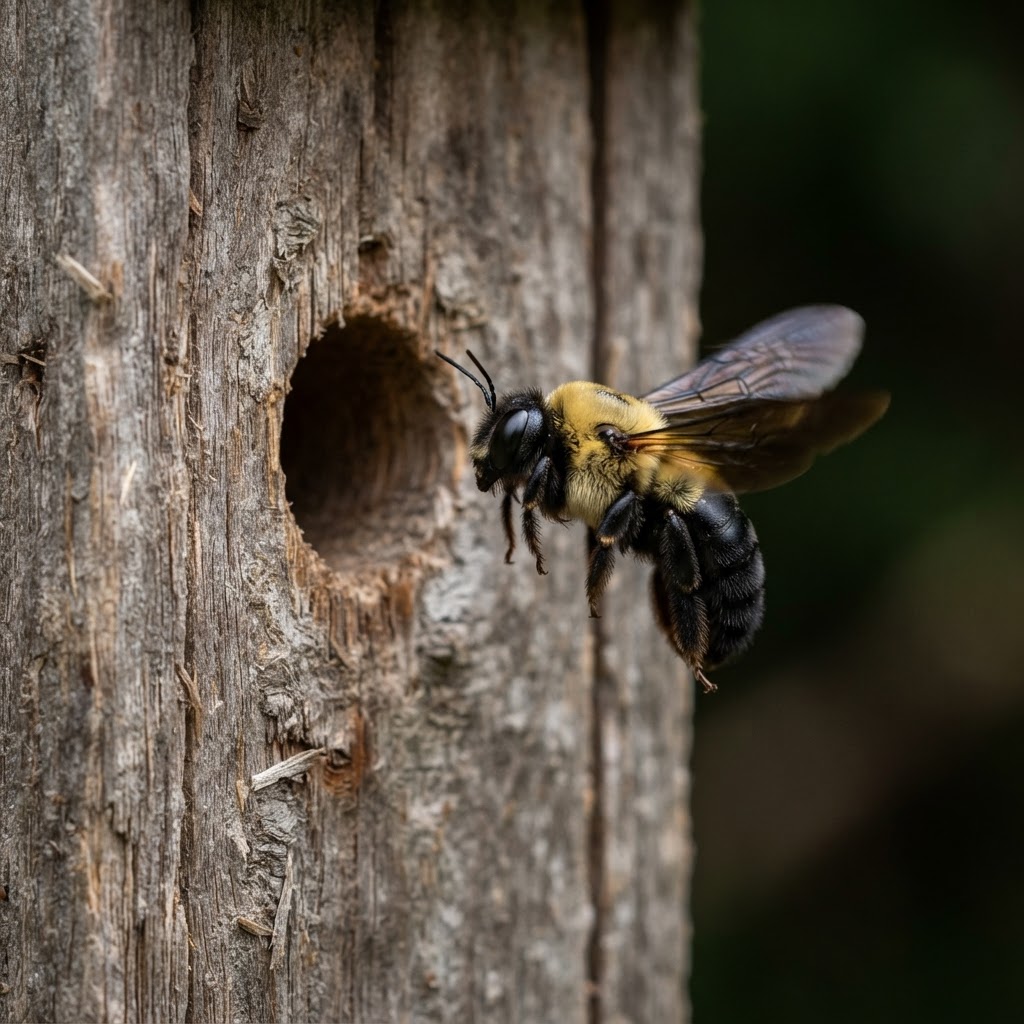
Carpenter bees are native pollinators and visit many flowers and crops. The problem is where they nest: females bore perfectly round, half-inch holes into unpainted, weathered, or soft wood to lay their eggs, tunneling inches into the grain. A few holes are no big deal, but year after year the same boards get reused and the tunnels branch and deepen, weakening decks, siding, fascia boards, and fence posts. Woodpeckers then drill into the wood to eat the larvae, causing much more visible damage. They rarely sting, but the property damage is why people call.
What They Do in the Winter
Carpenter bees overwinter as adults inside their old nest tunnels. They emerge in spring to mate, and females start new tunnels or extend old ones. Multiple generations can use the same piece of wood over years, which is why damage compounds.
- Adults overwinter inside their old nest tunnels and emerge in spring.
- Females mate, then bore new tunnels or extend existing ones.
- Multiple generations can reuse the same boards over several years.
- Tunnels branch and lengthen each season, weakening the wood over time.
Nesting
Females bore perfectly round, 1/2-inch holes into unpainted, weathered, or soft wood — decks, siding, fascia, fence posts, and play sets. Tunnels run with the grain and branch into galleries for eggs. They do not eat the wood; they nest in it. Males hover aggressively outside but cannot sting.
Diet
Carpenter bees feed on nectar and pollen from flowers. They do not eat wood — they only bore into it to make a nest. Larvae are fed a mix of pollen and nectar sealed inside the tunnel cells.
- Nectar from flowers (adults)
- Pollen from flowers (adults and larvae)
- Pollen-and-nectar paste (fed to larvae in the tunnel)
- They do not eat wood — they only nest in it
Fast Facts
A carpenter bee hole looks like it was drilled with a 1/2-inch bit — the clearest sign of activity, often with sawdust below.
The bees that hover aggressively at face height outside a nest are males — they have no stinger. Females can sting but rarely do.
Carpenter bees have a shiny, hairless abdomen; bumble bees are fuzzy all over. That smooth rear end is the quick ID.
They bore into wood only to nest — the sawdust is kicked out, not eaten.
Woodpeckers often drill into the wood to eat the larvae inside, causing far more visible damage than the bees did.
Painting or varnishing wood is the best prevention — they prefer bare, weathered, or soft wood.
When to Call Mid State
Carpenter Bees nests near your home, deck, or play areas are a real safety risk — they can sting repeatedly and swarm when disturbed. Don't treat a large nest yourself. Our team removes them safely and treats the area to prevent rebuilding.